Magistral – AI that works on your computer
A macOS and iOS app that automates work locally: watched folders, scheduled tasks, “Coworks” between several AIs and tasks sent from your phone.
- Role
- Co-founder & backend engineer
- Period
- 2023 – present
- Technologies
- PythonFastAPILLMsLocal models

In short
Magistral turns a computer into an autonomous assistant. Instead of chatting with an AI, you hand it work: watch a folder, run a scheduled task, process a document sent from your phone. I co-founded the project and I build its backend.
What Magistral does
- Watched folders: each folder has its own rules for incoming files.
- Scheduled tasks: a morning briefing, overnight email sorting and so on.
- Coworks: workflows where several AIs pass the file along, each with its own role. A local model can anonymise a document before an online model analyses it.
- Built-in local AI: an open-source model runs on the machine with no subscription. Magistral can also drive the subscriptions you already pay for (Claude, Gemini, OpenAI Codex, Mistral).
- Webhooks and forms: a website form or a third-party app can trigger local processing.
- Mobile app: photos, scans and voice memos go from the phone to the computer; if it is off, they wait on a secure gateway hosted in Paris.
Magistral is available on macOS and iOS; Windows and Android are announced.
On the backend
- AI services in Python and FastAPI.
- Data pipelines for model training and inference.
- API infrastructure designed for thousands of concurrent requests at low latency.
Where it started
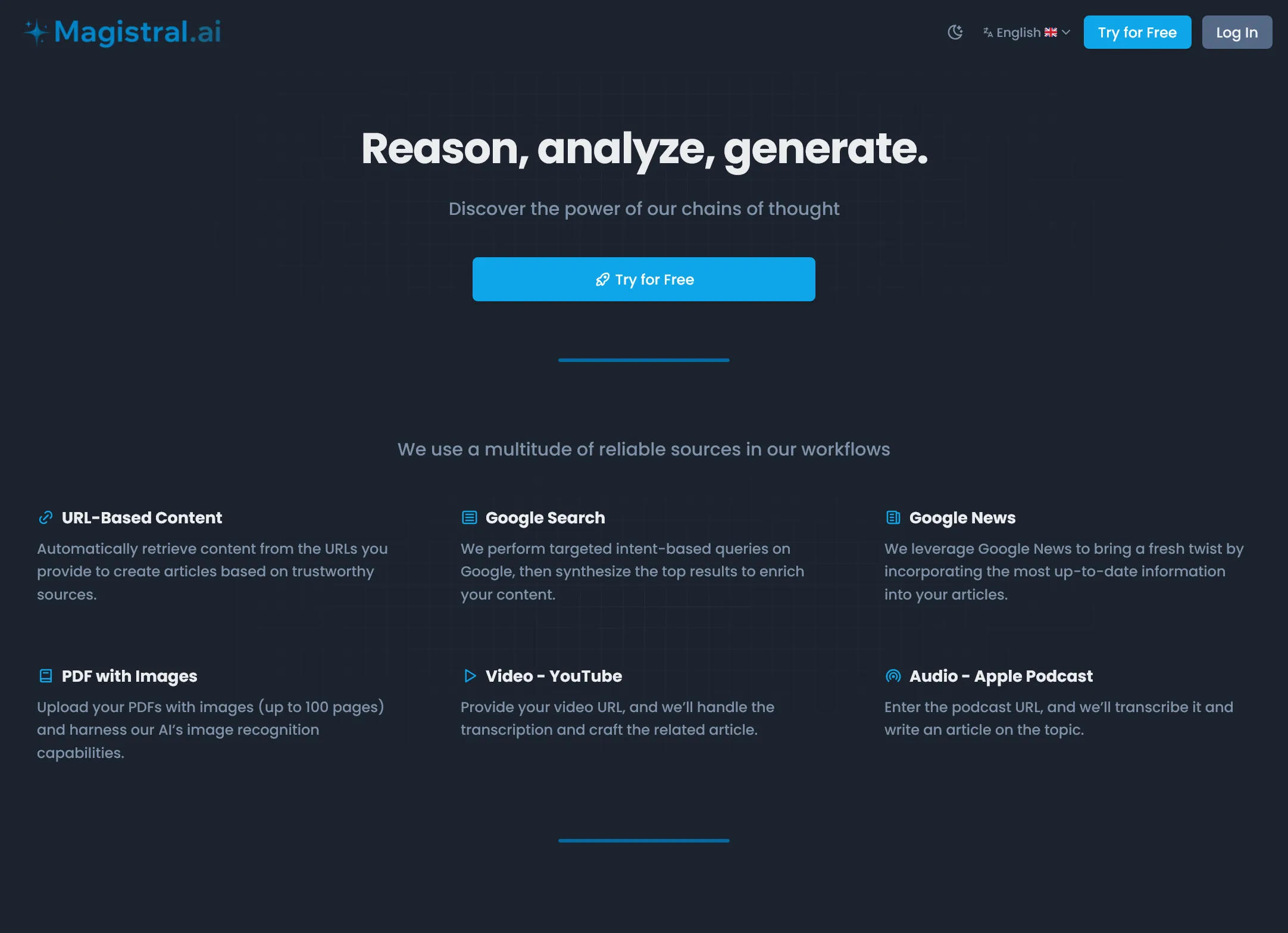
The first version of Magistral generated articles with AI from sources: web pages, Google Search, Google News, illustrated PDFs of up to 100 pages, YouTube videos and podcasts, using chains of reasoning to structure the content.
Screenshots